

1. Explain it simply
Every Pinyin syllable is sung, not shouted. The vowels and consonants stay the same, but the pitch contour you put on top changes the meaning entirely.
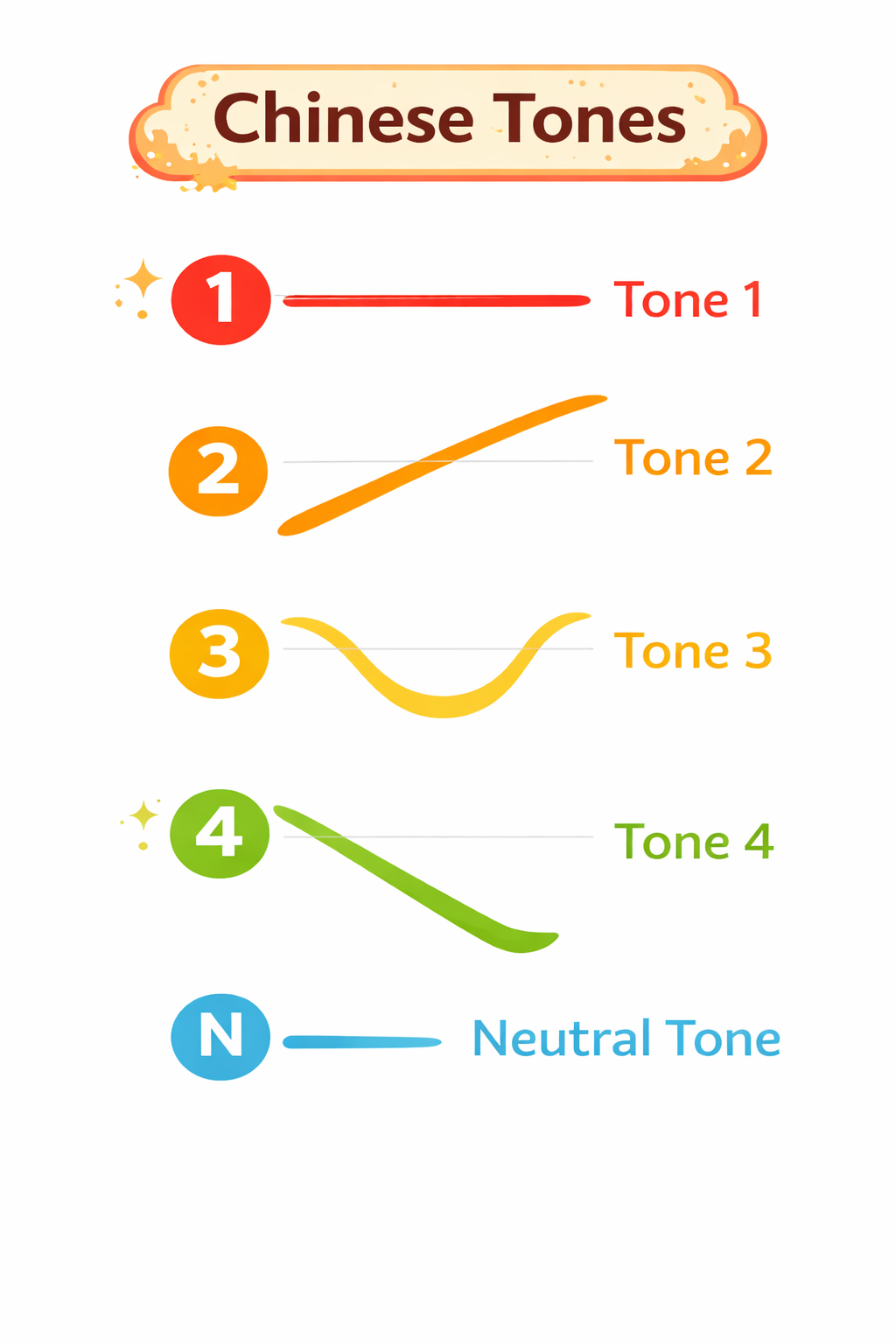
Tone 1 holds steady on a high pitch, Tone 2 glides upward, Tone 3 dips before popping back up, Tone 4 drops sharply, and the neutral tone stays light and quick. Think of them as five shapes you trace in the air.
When you practice, exaggerate the melody first and add the consonants after. Prioritize the contour and breath flow-volume isn't what makes the tones correct.
2. Examples + Practice
Tip: Pair the tones with body motion-snap your fingers high and level for Tone 1, sweep upward for Tone 2, draw a deep checkmark for Tone 3, and chop downward for Tone 4.
Practice: Lock it in with a focused drill that cycles through every tone on the same syllable.
妈
mā
mom
Tone 1 · high level
麻
má
numb/hemp
Tone 2 · rising
马
mǎ
horse
Tone 3 · dipping
骂
mà
scold
Tone 4 · falling
吗
ma
question particle
Neutral · light
3. Neutral Tone (轻声)
The neutral tone is short and light. It does not carry its own pitch contour; it borrows energy from the previous syllable.
Keep it quick and unstressed. If you give it a full tone, the rhythm feels unnatural.
吗
ma
question particle
Neutral
呢
ne
ending particle
Neutral
的
de
possessive
Neutral
朋友
péngyou
friend
Second syllable is neutral
4. Tone Sandhi: 不 & 一
不 (bù) changes to bú before a 4th-tone syllable. 一 (yī) changes to yí before a 4th-tone syllable and to yì before 1st/2nd/3rd tones.
In counting or when said alone, 一 stays yī.
不是
bùshì
Sandhi:búshì
is not
bù → bú before 4th tone
不忙
bùmáng
not busy
bù stays before 2nd tone
一次
yīcì
Sandhi:yícì
one time
yī → yí before 4th tone
一年
yīnián
Sandhi:yìnián
one year
yī → yì before 2nd tone
5. Third Tone Sandhi
When two 3rd tones are together, the first one is pronounced as a 2nd tone. Example: nǐ hǎo is spoken ní hǎo.
Pinyin in textbooks often keeps the original tone marks, but in speech you must apply the change.
你好
ní hǎo
hello
3rd + 3rd → 2nd + 3rd
很好
hén hǎo
very good
3rd + 3rd → 2nd + 3rd
水果
shuíguǒ
fruit
3rd + 3rd → 2nd + 3rd
6. Third Tone Chains (3-3-3)
When three 3rd tones appear in a row, the pattern becomes 2-2-3 in natural speech.
Train your ear to hear the two rising tones before the final low dip.
我很好
wó hén hǎo
I am very good
3-3-3 → 2-2-3
你也好
ní yé hǎo
you too
3-3-3 → 2-2-3
我想走
wó xiáng zǒu
I want to leave
3-3-3 → 2-2-3